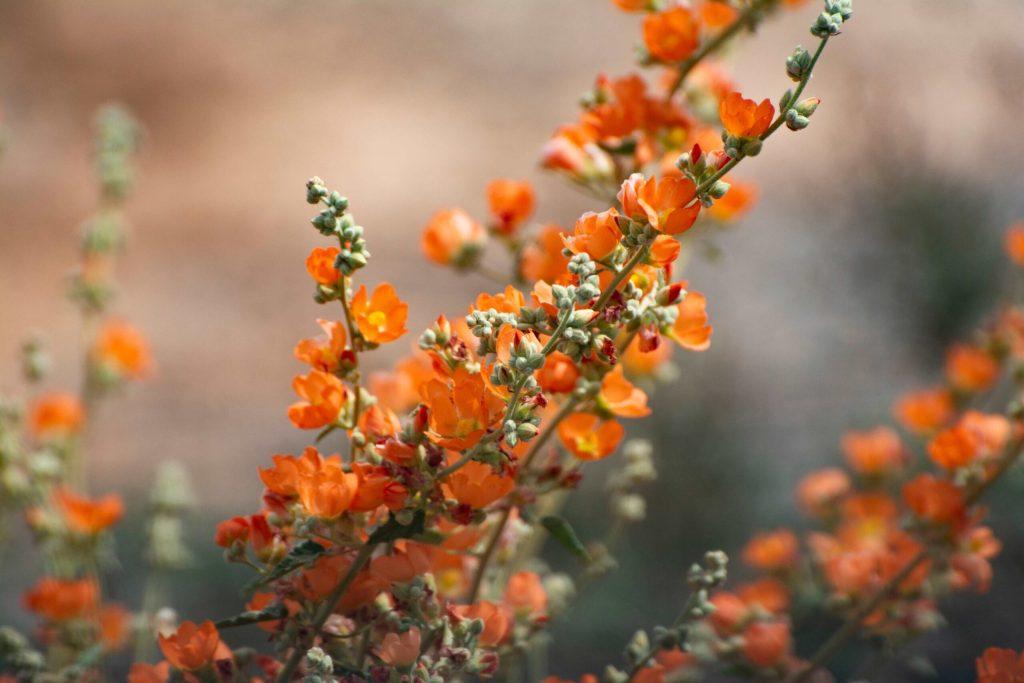
Scarlet Globemallow is a 6- to 14-inch-tall long-lived native plant found throughout the inland west from dry, open valleys to the mountain foothills and beyond, at elevations between 3,500 to 9,000 feet. Its reddish-orange to pinkish flowers bloom from April to August depending on elevation. Although technically a forb, it is also considered a sub-shrub because of its woody base and taproot. Scarlet Globemallow is a common plant of the pinyon-juniper zone. It is a desirable forage for deer, antelope, and bighorn sheep, as well as small mammals and birds. It is also is an excellent forage for domestic sheep, particularly when grasses are dormant.
Scarlet Globemallow prefers full sun and dry soils. It tolerates a wide range of soil textures from coarse to medium fine and can tolerate both alkaline and moderately saline soils. Its roots develop mycorrhizae which not only help the plant extract nutrients, but can help improve soil structure and increase organic matter. Established plants send out rhizomes from which new plants can potentially sprout. Because of all these traits and its forage value for wildlife, Scarlet Globemallow can be an important component of mixes to reclaim disturbed land.
Scarlet Globemallow is also a good plant for xeriscape gardens and landscapes and if it gets some supplemental moisture it can grow twice as tall as in the wild. Seeds should be planted no more than 1/4 inch deep, preferably in the Fall to help break dormancy. The seed has a hard coat, so mechanical scarification can also enhance germination. Hairs on the seed can be an extreme eye irritant, so take care when handling. For a tidy appearance, the dried stalks can be removed just before new growth starts in the spring. Otherwise Scarlet Globemallow requires no maintenance.